


Stop stockouts, eliminate revenue leaks, and make every retail decision accurate with Sifflet.
Proactive data observability for FSI services.






Complex retail data makes it %%hard to trace%% and explain inventory, personalization, and pricing issues.

Demand Forecasting Failures
Retail forecasting is only as good as the data behind it. Late, incomplete, or incorrect inventory and sales data causes forecast drift, driving overstock or stockouts—issues that cost retailers 2–4% of annual revenue and over $1T in lost sales globally.

Broken Customer Data for Personalization
Personalization engines rely on unified customer profiles, but schema changes, failed identity resolution, or silent ETL errors create stale data, reducing recommendation relevance, campaign targeting, and marketing ROI by 15–25%.

Pricing and Promotion Data Errors
Dynamic pricing and promotions depend on accurate real-time data. Broken feeds or inconsistent tagging can cause revenue leakage, margin loss, and compliance issues—even a 1% error on $500M revenue equals $5M at risk.
Complex FSI data pipelines make it difficult to pinpoint and explain reporting, model, and customer-data issues.

Regulatory Reporting Failures
Financial institutions face strict reporting requirements under Basel III, SOX, and AML. Late or incorrect data often leads to errors discovered at deadlines, contributing to over $10B in fines globally, with individual penalties in the tens of millions.

Fraud and Risk Model Degradation
Fraud and credit risk models rely on accurate, timely data. Silent pipeline failures or data drift can degrade performance, contributing to 20–30% of false negatives and increasing fraud losses or mispriced risk.

Customer Data Inconsistencies Across Channels
FSI firms consolidate customer data for cross-sell and personalization, but fragmented pipelines create incomplete profiles and broken 360° views, costing 15–25% of revenue in missed opportunities and higher servicing costs.
How Data Observability Solves %%Your Problems%%
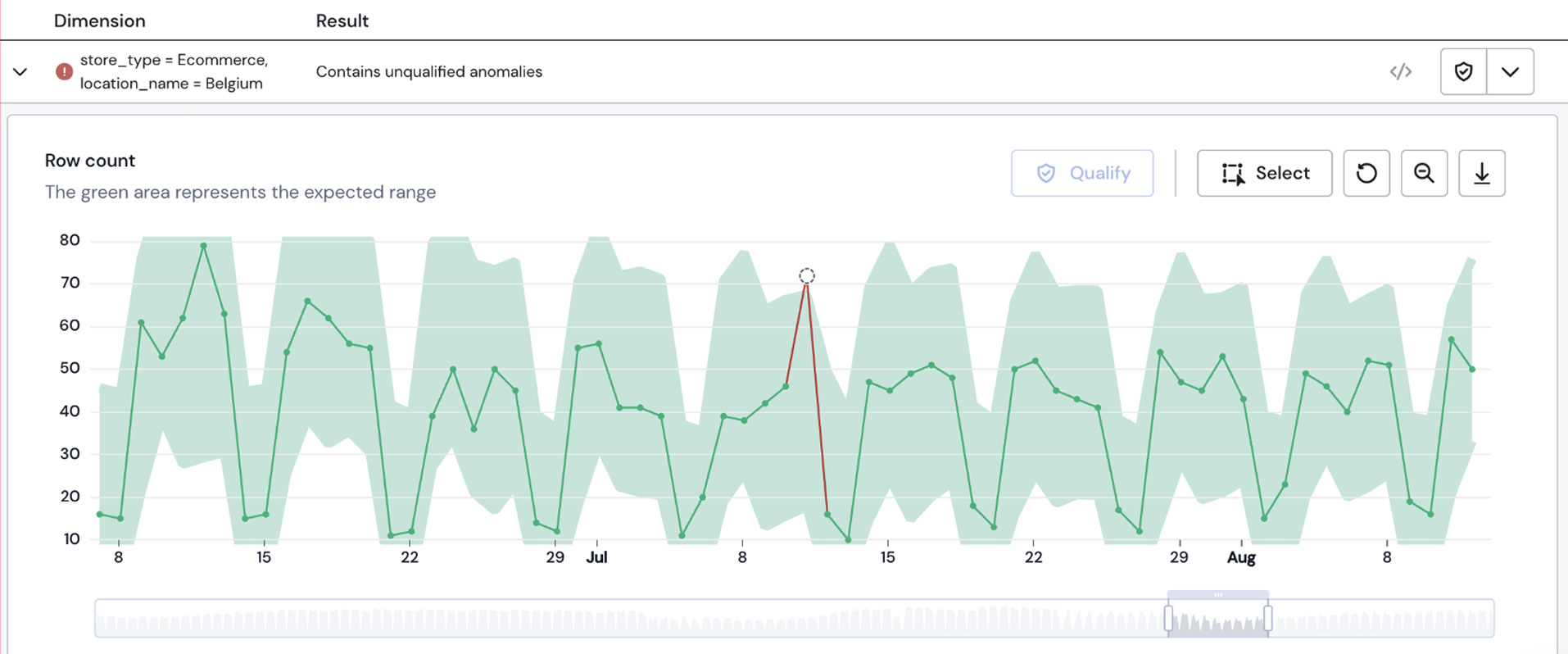
Detect anomalies in inventory and sales data before they reach forecasting models; alert on late-arriving or malformed data
Monitor identity resolution pipelines and profile completeness; catch schema drift in CDP inputs
Validate pricing feeds and promotional tagging in real time; flag discrepancies before they hit production
What Others Retail Leaders %%Had To Say%%
“With Sifflet, we improved retail data reliability across stock, sales, marketing, and customer metrics. Marketing and sales teams gain clearer insights into campaigns and customer loyalty, leading to better stock alignment, fewer payment errors, and higher customer contactability.”
“Sifflet makes data understandable for everyone and allowed the team to go from no monitoring to meaningful insight in only a few days.”
How Data Observability %%Solves%% Your Problems
Monitor upstream data freshness and schema integrity; alert before reporting deadlines are at risk
Track data inputs to ML models for drift, latency, and completeness; catch issues before model performance declines
Validate data reconciliation across source systems; monitor identity resolution and profile completeness

What Others FSI Leaders %%Had To Say%%
“Sifflet gives us clearer visibility into fraud, solvency, and efficiency. We reduced manual delays and now rely on cleaner data for faster reimbursements and better insurance analytics.”
“With Sifflet, we’re gradually extending data reliability across our analytics, market referential, regulatory, CRM, finance, and issuance domains.”
Use cases
Sifflet helps retail teams protect revenue and customer trust across their most critical data-driven use cases.
The challenge: Thousands of SKUs. Multiple channels. Constant volatility.
The Sifflet edge: Real-time tracking, automated data checks, and anomaly detection help prevent stockouts and costly errors before they impact revenue.
The challenge: Inconsistent pricing across platforms leads to lost margins and customer frustration.
The Sifflet edge: Continuous pricing validation across all systems ensures promotional integrity and customer trust.
The challenge: Data silos cause fragmented profiles and disconnected experiences.
The Sifflet edge: A unified view of customer data enables personalization and stronger loyalty programs.
The challenge: Outdated forecasting models miss real-world volatility.
The Sifflet edge: ML learns from historical sales, competitor pricing, and external signals to fine-tune demand planning.
Use cases
In highly regulated FSI environments, these use cases show how Sifflet brings control and accountability to complex data ecosystems.
Centralizes technical lineage, business definitions, usage patterns, quality, and compliance classifications.
Maps data changes directly to risk models, reports, and customer applications, making lineage accountable.
Intelligent agents detect, triage, and resolve data issues autonomously, coordinating fixes across systems at scale.


If Snowflake is the engine powering your data operations, Sifflet is the control tower. Our native integration ensures you get deep visibility into data quality, lineage, and governance—all built specifically for teams running mission-critical workloads on Snowflake.
Looking for more?




Frequently asked questions
Let’s Chat About Your Data Observability Needs
Let’s Chat About Your Data Observability Needs
















-p-500.png)
