
Snowflake has made it easier than ever to put AI directly on governed data. With Cortex AI Functions and Cortex Agents, teams can ask questions of their data where it sits. But easy access raises a hard question: can you trust what the AI will find?
An AI model won't tell you that a table stopped refreshing two days ago, or that an upstream schema change broke a metric downstream. It will answer anyway, confidently and at scale.
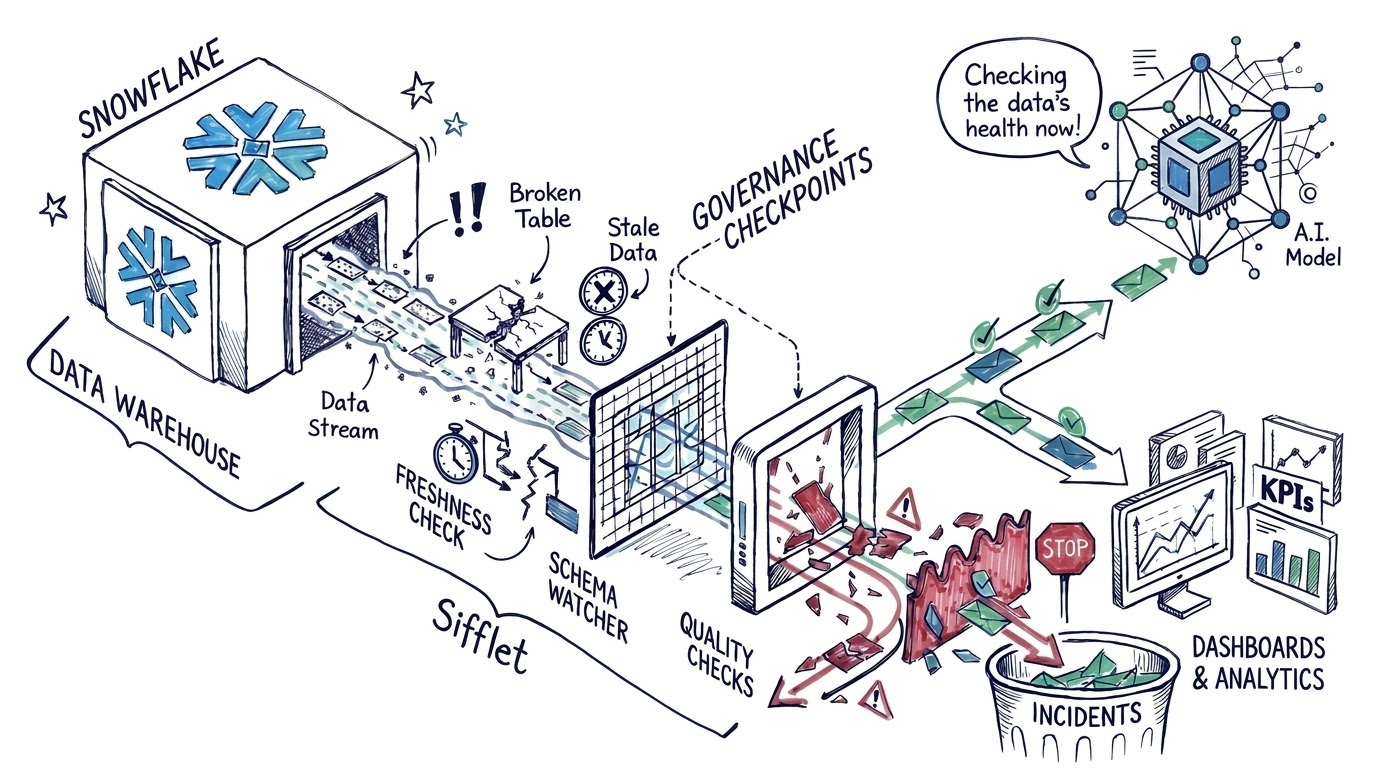
The model can't judge the data it's given, so trust has to be built in around it: at the point where your AI reads data, while data moves through your pipelines, before code changes ship, and at the moment the AI answers. That's what Sifflet adds to your data stack.
Start with what your AI actually reads
Cortex Agents answer questions about structured data through Cortex Analyst, which generates SQL against semantic views. The tables behind those views are your AI's real inputs, and that's where monitoring should start.
In Sifflet, you can group those tables into a data product with named owners. Sifflet then watches the product's entire upstream lineage, however many levels away, and can alert the product's team when an upstream incident puts it at risk. Owners hear about a problem before anything inside the product itself turns red.
Know when, and what, went wrong
The first sign of bad data is usually a technical signal, such as a table syncing later than usual or a drop in row count. The tables feeding your AI need ongoing monitoring for three things:
- Freshness and volume. Tables update when they should, with the volume you expect.
- Schema. Changes to structure are caught before they break downstream logic.
- Quality. Duplicates, missing values and out-of-range metrics are flagged early.
Sentinel, Sifflet's monitoring agent, analyses metadata and suggests monitors for individual assets or a whole data product, which you review and create in a few clicks. With Sentinel, you can quickly extend coverage to the assets that need it most.
But technical signals alone don't tell you how critical a breakage is, who is affected or where it started. Without that, every alert is just more noise for teams running dozens of tools.
Sifflet adds that business context. Each incident lists the downstream dashboards it affects, and Sifflet shows who owns each asset and how much it's used, so you can see what's at stake before you prioritise. That way, the metric on an executive dashboard that gets checked every week can take priority over the report nobody opens.
Lineage shows where a problem started and how far it reaches. Sifflet provides field-level lineage inside Snowflake, plus end-to-end lineage out to BI tools such as Looker and Tableau. You can trace a failing column back to the upstream change that caused it, and forward to every dashboard that depends on it. When the cause isn't obvious, Sifflet's root-cause agent, Sage, analyses the incident, its lineage and dbt run logs, then summarises what happened, the likely root cause and next steps.
Stop bad data before it reaches your AI
Knowing about a problem isn't enough if bad data has already reached your AI. Sifflet gives you two ways to stop it earlier:
- Before a change ships. Sifflet's dbt impact analysis runs on every GitHub pull request or GitLab merge request that changes dbt models, and lists the downstream tables and dashboards the change could affect, so reviewers see the risk before merging.
- While the pipeline runs. Flow Stopper lets your orchestrator run Sifflet's quality checks after each transformation step. When a check fails, the pipeline stops before bad data can reach your AI models or other consumers.
Let your AI check before it answers
The last point of trust is the AI itself. The Sifflet MCP Server makes Sifflet's view of your data (asset metadata, active incidents and downstream impact) available to AI tools that support the Model Context Protocol, such as Cursor and Claude Desktop. Instead of answering blind, an assistant connected to it can check whether the data it's about to use has open incidents.
One control plane, from code change to answer
Your data doesn't start or end in Snowflake, and neither should your view of its health. Sifflet gives your team and your AI tools a single control plane across the data stack that brings together data health, lineage and business impact, from the first code change to the final answer.
An AI-readiness checklist for your Snowflake data
Before pointing AI at a dataset, ask:
- Do we know which tables feed our AI use cases, and are they grouped into data products with clear owners?
- Are freshness, volume and schema monitored on those tables?
- Do we have quality checks on the metrics people act on?
- Can we trace any issue back to its source and forward to its impact?
- Are alerts prioritised by business impact, so the team fixes the right thing first?
- Do we catch risky changes before they ship, and can a failed check stop the pipeline before bad data lands?
- Can our AI tools see when the data they rely on is unhealthy?
If the answer to any of these is "not yet," that's where to start.
How Dynex Capital, Inc. built a trusted data foundation on Snowflake
Dynex Capital, Inc., an Agency-focused mortgage REIT with a long track record of generating dividends from high-quality mortgage assets, rebuilt its data stack around Snowflake. As Dynex's Snowflake footprint grew, the data team wanted its data operations to keep pace. That meant moving from email-based alerts to focused, actionable notifications, getting to the root cause of issues faster, automating reconciliation, and setting up a clear process for onboarding new data assets.
With Sifflet, Dynex has:
- A structured framework for onboarding new data assets with quality rules and freshness checks.
- Faster root cause analysis for reconciliation breaks.
- Centralized cataloguing and monitoring of its secure Snowflake data shares.
- Improved risk management and faster enablement of analytics and reporting.
Dynex bought Sifflet through the Snowflake Marketplace.
"Snowflake lets us scale our data platform quickly, and Sifflet helps us do it with confidence. Building quality rules and freshness monitoring into every new data asset from the start lets us grow while keeping strong data governance." – Soffia Shukhman, Head of Data, Technology, Architecture and Innovation
Get started
Sifflet is available on the Snowflake Marketplace, and customers can buy it with their Snowflake committed spend. Sifflet is SOC 2 Type II and ISO 27001 certified, and can run fully managed or self-hosted. Connect your Snowflake instance and see the whole picture.
To learn more about Sifflet, visit siffletdata.com.