
The challenge
As AI agents start consuming and acting on data, the cost of bad data rises. Agents will act on data without truly understanding what it means, or whether the user’s definition of a particular data asset is the same as the agent’s.
Take a simple request: “Send a renewal reminder to every current customer.” In your CRM, a customer is anyone at the ‘Customer’ lifecycle stage. Finance counts anyone with an active contract. The product team counts anyone whose instance is still running. These lists rarely match. Some accounts have signed but still show as leads. Others have churned but are still logged in. A person would notice the gaps, but an agent just picks a definition, sends the emails, and reports success.
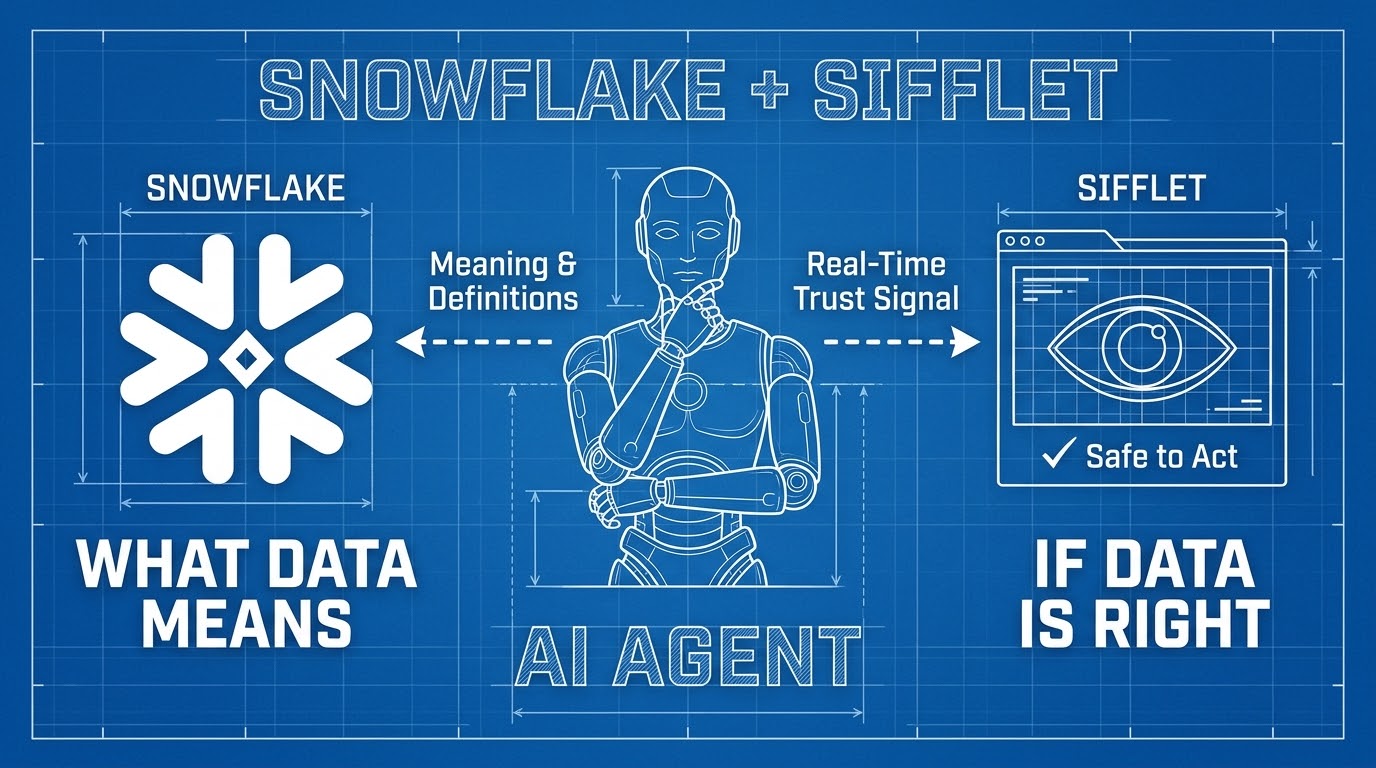
So how do we correct this? One of the most commonly claimed solutions is a semantic layer between the data and agents. But a semantic layer only tells an agent what data means. It does not tell it whether that data is correct right now.
To get agents to a state where they can be trusted to act on your data, both these components are necessary. Snowflake’s introduction of Horizon Catalog covers the first part. Sifflet covers the second.
Extending correctness beyond the warehouse
Snowflake governs your data and defines what it means. Beyond the semantic layer, you’ll also get access to quality checks, telemetry and agents directly inside Snowflake.
But your data doesn’t just live in Snowflake. It gets there from a number of sources. It flows into Snowflake, then gets piped to a multitude of apps and agents, undergoing countless transformations on the way. Sifflet covers the field to the left and right of Snowflake.
Going across the warehouse’s boundary, Sifflet monitors your data as it flows into and out of Snowflake to make sure it stays fresh and reliable wherever it goes. If issues occur, it traces them upstream to the root cause, uses lineage to qualify the impact, and closes the loop by getting the incident information to the people and into the systems that need it for remediation.
The biggest piece in this context though; Sifflet provides a real-time trust signal through the MCP (Model Context Protocol) that can be integrated into workflows or used by agents. Through the MCP, agents get a view of:
- Metadata for all assets: schema, owners, tags. (What data is it? Who owns it? What is it used for?)
- Existing monitors and their configuration (Is the data kept clean?)
- Data incidents detected by Sifflet (Is the data safe to use right now?)
- Downstream impact of changes and incidents (If the data breaks, who’s affected?)
Better together
With Sifflet and Snowflake together, your analysts and AI agents work on data that is both governed and continuously checked for correctness. Here’s how the two work better together:
- Snowflake provides Data Metric Functions (DMFs): native checks for nulls, duplicates, freshness and volume on data inside Snowflake.
Sifflet adds custom and AI-recommended monitoring: Sentinel, Sifflet's monitoring agent, recommends monitors from Snowflake metadata, usage and lineage; you choose which to create. 20+ templates, no manual rule-writing. - Snowflake provides Snowflake Trail: telemetry (logs, metrics, traces) for pipelines, apps and compute.
Sifflet adds root cause across the stack: Sage, Sifflet's root-cause agent, traces incidents through sources, dbt, Airflow, Snowflake and BI. - Snowflake provides Horizon Catalog & Horizon Context: governance and shared business meaning.
Sifflet adds business impact: column-level, end-to-end lineage that shows which dashboard, model or decision is at risk, and who needs to know. - Snowflake provides Cortex AI & agents: AI on governed data.
Sifflet adds a real-time trust signal for AI: the Sifflet MCP (Model Context Protocol) Server lets AI tools check which data is safe to use before they act. - Snowflake provides Snowflake-native objects.
Sifflet adds coverage of Snowflake-specific objects such as streams, dynamic tables and external tables, plus usage statistics, tags and metadata.
In conclusion
Let’s go back to that renewal request we talked about earlier. With a shared definition of “current customer” in Snowflake, the agent knows which list to use. With Sifflet, it can check whether that list is fresh, whether any open incidents affect it, and who owns it, before it sends a single email. If the data is out of date, the agent stops and flags it rather than emailing the wrong people. The agent and the request are the same; what’s different is that the data has been defined and checked first.
Get started
Sifflet is available on the Snowflake Marketplace, and you can purchase it with your committed Snowflake spend. Connect your Snowflake instance and see the whole picture.
To learn more about Sifflet, visit siffletdata.com.