
.avif)

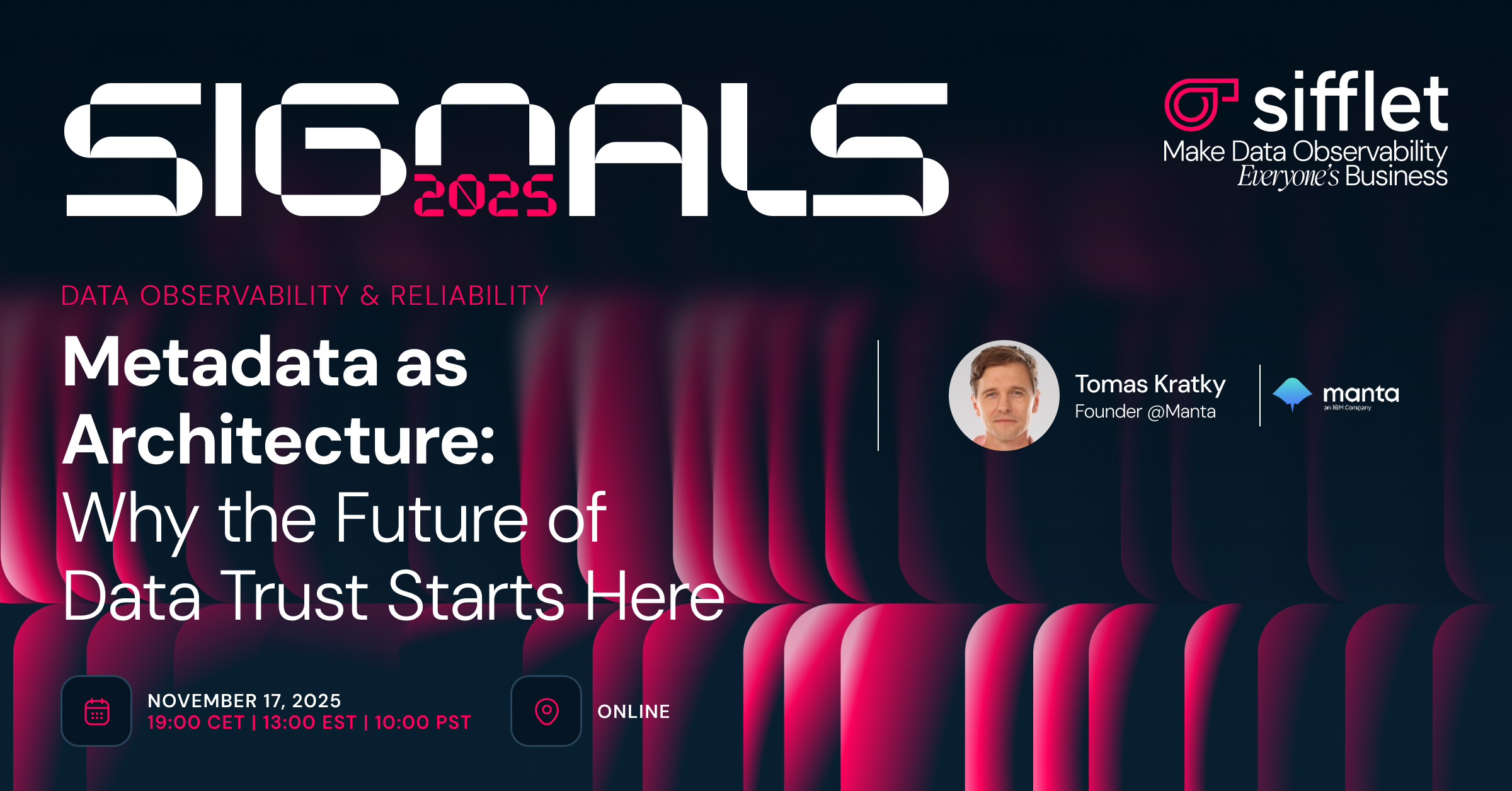
There is a particular kind of talk that is easy to spot by the third slide: the speaker knows their stuff cold, has no interest in performing enthusiasm, and is not going to pretend the industry has solved problems it has not. Thomas Kratky, founder of Manta and one of the more clear-eyed voices in the metadata management space, gave exactly that kind of talk at Signals25.
The title was Metadata as Architecture: Why the Future of Data Trust Starts Here. The argument, unpacked over thirty focused minutes, is that metadata is not documentation. It is not a data catalog feature. It is the enterprise context that makes the difference between AI agents that produce noise and AI agents that produce decisions.
If you missed it live, the rewind is available on the Signals25 page. What follows is our take on the session, with the moments that stuck.
Why enterprise AI is failing: the context gap
Kratky opened with a framing almost everyone in the room had seen a version of before. ChatGPT's user growth is vertical. Enterprise AI experimentation is near-universal among companies above $500M in revenue. And yet measurable business impact from Gen AI — in the P&L of large enterprises, in cost structures, in revenue — is largely absent. The studies he cited were McKinsey and MIT. Not fringe sources.
His diagnosis identified three root causes: unrealistic expectations driven by hype, unsolved orchestration for complex agentic workflows, and — the one nobody is fixing — missing enterprise-wide context.
"We expect AI to do a similar or better job, but we don't provide any training at all or very limited training. And we don't provide any context."
MCP is not context, he pointed out plainly. It is an API. It describes how to access data, not what the data means — not how your organization defines revenue for a board presentation versus a fundraising deck versus a regulatory filing. That gap is where most enterprise AI deployments quietly fall apart.
Gen AI versus traditional AI: a fundamentally different trust problem
The comparison Kratky drew between classical AI and Gen AI was brief but worth pausing on, especially for teams evaluating their metadata management strategy.
Traditional AI — fraud detection, credit scoring, recommendation engines — was narrow, deterministic, trained on curated labeled data, and measurable. You could tell if it worked. Gen AI operates differently across almost every dimension: open-ended tasks, no single correct answer, qualitative validation that is inherently subjective, and nearly impossible to benchmark cleanly.
"We historically didn't trust AI just because it was perfect. It was definitely not perfect, but it was simply well contained. And that's the difference now."
Without enterprise context encoded in a structured metadata layer, AI agents have no way to distinguish between five competing definitions of the same metric, no way to identify which pipeline is authoritative, and no way to apply the organizational knowledge that took decades to accumulate. Metadata management is not a nice-to-have in this environment. It is the prerequisite.
The three layers of enterprise metadata
Kratky was precise about what he meant by metadata, because the word has been stretched into near-meaninglessness by a decade of data catalog marketing. He organized it into three layers, each essential for AI agents to reason reliably:
Technical metadata covers tables, columns, transformations, lineage, and the structural logic of how data moves through your stack. It tells an AI agent where things live and how they are connected.
Business metadata covers metrics, KPIs, objectives, and business glossary terms. It tells an AI agent what things mean and why they exist.
Trust metadata covers data quality scores, PII classification, privacy tags, and security policies. It tells an AI agent how much to rely on a given asset and what it is permitted to do with it.
Bring all three layers together, and you have something an AI agent can actually orient itself within. Miss any one, and you are asking agents to navigate an environment they cannot read. This is exactly what Sifflet's approach to metadata observability is built around: treating metadata as a living, monitorable asset rather than static documentation.
The unification trap: why good metadata management intentions fail
One of the sharpest observations in the session came from Kratky's decade of watching enterprise metadata programs fail in a very specific way.
The instinct, when building a metadata management layer, is to unify everything. One definition of revenue. One canonical business glossary. One source of truth. It is logical on paper. In practice, it tends to produce a project that takes five to ten years, costs more than anyone budgeted, and ends with no one using the system.
"Consolidate, but don't unify at all costs."
A large enterprise with five thousand people has tens of different business functions, each with legitimate, context-specific reasons for defining the same metric differently. The goal is not to force alignment. It is to make all those definitions accessible, transparent, and usable — so an AI agent can understand that when the CFO asks about revenue, she means something different than what the sales operations team means, and that both definitions are valid in their respective contexts.
The alternative — a federated, slightly messy, connected fabric of metadata that covers the environment without flattening it — is less elegant and far more functional.
The vendor lock-in problem: why enterprise metadata is trapped
Kratky was direct about where the metadata ecosystem is currently failing enterprises.
BI vendors and analytics platforms have every incentive to keep their metadata layers proprietary. A rich business context layer is precisely what makes their product sticky. They will not share it voluntarily. The result: the metadata most valuable for grounding AI agents is scattered across systems, locked behind proprietary interfaces, and effectively inaccessible to the agentic workflows that need it most.
Open standards exist. None have meaningfully caught on. Kratke's read was honest: he does not see the industry working hard enough to change this, but enterprises should pressure their vendors regardless. The compounding value of open metadata access becomes very significant once you run agents at scale.
Does metadata management actually improve AI accuracy? The evidence
The studies Kratky cited are early and should be treated as directional, but the signal is consistent enough to act on.
Providing structured metadata context to AI models — even basic technical metadata describing warehouse structure and table relationships — improves accuracy on complex questions by 10 to 50% depending on the task. In healthcare settings, where model reliability is non-negotiable, structured metadata access has been associated with accuracy improvements in the 20 to 40% range.
The deeper question is whether AI can infer meaning from data at scale, without explicit metadata. Kratky was skeptical, and for good reason.
"No metadata vendor so far was successful in getting that context from our brain to assist them. Not at scale."
The institutional knowledge that makes enterprises function — the thirty-year understanding of how a particular system was built, why a field is named the way it is, what a number actually represents in context — lives in people's heads. Large language models do not change that. If anything, they raise the stakes for solving it, because the volume of decisions AI agents are now being asked to make demands that this context be encoded, accessible, and trustworthy.
A practical metadata management roadmap for AI readiness
Kratky closed with guidance that ran against the grain of most vendor pitches. No silver bullets. No five-year transformation programs. Just a sequence that actually works.
Build an inventory before anything else. Consolidate what you have. Do not attempt to unify definitions across the organization before making existing metadata accessible. Consolidation delivers immediate value; forced unification is expensive and often pointless.
Demand open interfaces from your vendors. The ability to expose metadata through standard APIs is what enables AI agents to consume it. Lock-in is a long-term architectural problem that starts with early tool choices.
Treat metadata as a first-class asset. Static documentation is not metadata management in any meaningful sense. Metadata needs to be versioned, queryable, and observable. If your metadata layer cannot tell you when something changed and why, it is not fit for agentic use.
Pick narrow use cases. The implementations that fail are the ones trying to solve everything at once. One specific use case with clear value, shipped and measured, is worth more than a comprehensive program that never ships.
Feed metadata into your AI workflows now. RAG pipelines with metadata context are not complicated to configure. Based on available evidence, they are measurably better than RAG without it. Start instrumenting, start measuring, and iterate.
The larger bet: metadata management as the trust layer for AI
The closing argument was the one that has stayed with us since the session.
Metadata management has always existed to help humans find and trust data. Every data catalog, business glossary, and lineage tool built over the past fifteen years was oriented around that use case.
The shift is that the primary consumer of metadata is changing. AI agents need to find and trust data too — in a form they can consume, in real time, at scale. The organizations that have invested in making their metadata accessible, transparent, and connected will have a material advantage as agentic workflows become standard.
The gap between enterprises that have a working metadata foundation and those that do not is going to look, in a few years, a lot like the gap between enterprises that had clean data pipelines and those that did not in 2018. The ones who started early look prescient. The ones who waited are always catching up.
Kratky's closing line: "Just do it today, or start doing it today. Piece by piece, collecting metadata, using metadata for AI agents, and learning from the environment how to make it better."
That is as good a place to start as any.











-p-500.png)
