


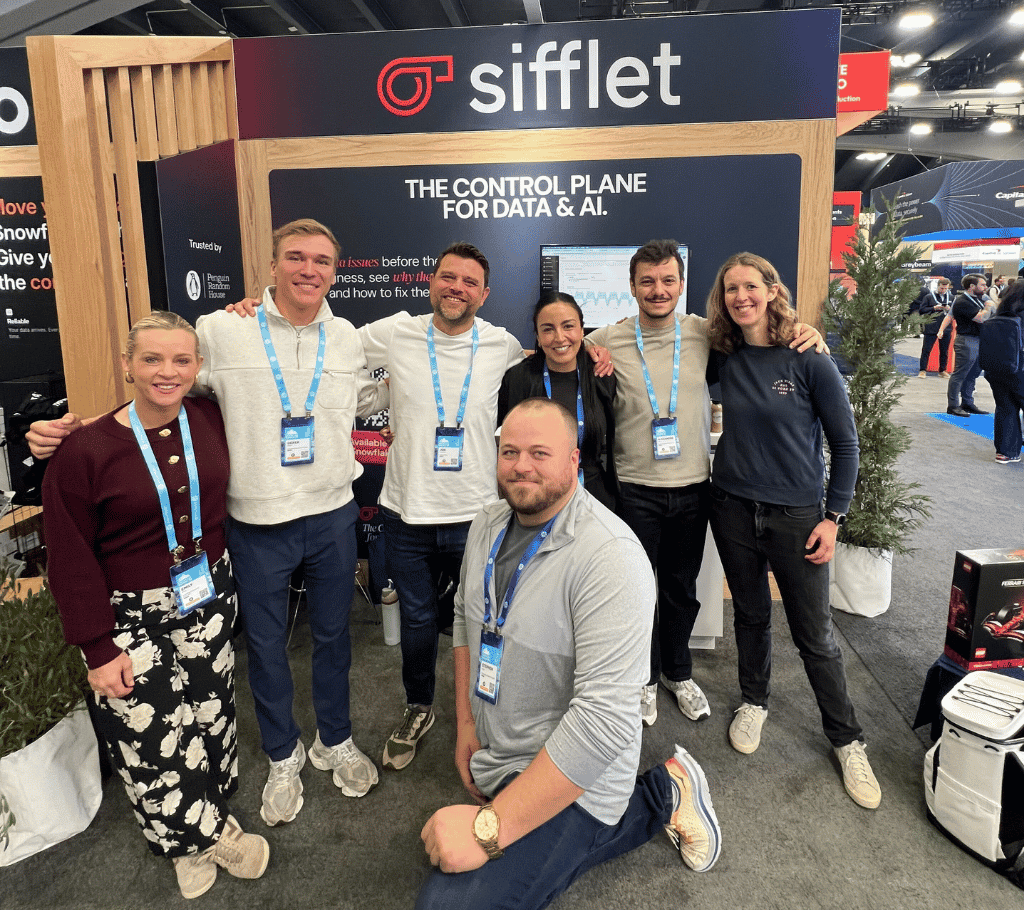
Snowflake opened Summit 2026 in San Francisco with one clear message: the experimentation phase of AI is over, and agents are starting to do real work across the business, continuously. Sridhar Ramaswamy framed the "agentic enterprise" around four pieces that have to come together: your enterprise data and context, AI models, the applications where work actually happens, and a coordination layer that ties them together.
That last piece got a name. Ramaswamy called it a new category: the agentic control plane.
It's a category we've been building toward for a while, so we paid close attention. Here's what stood out, and the question I think the keynote left open.
1. The control plane is now the center of gravity
Spin up agents in isolation and they make conflicting assumptions. A finance agent contradicts what supply chain just decided. A marketing agent acts without knowing what a support agent learned about the same customer an hour earlier. The control plane is the layer that keeps those decisions grounded in a shared, governed context.
Putting a name to it was useful, because it points at where the difficulty actually sits. Building agents is the easy part now. Getting them to work together without stepping on each other is the hard part.
2. Trust is what lets you move fast
Trust came up again and again. Ramaswamy was clear that the goal isn't just unified data, it's data you can actually trust for AI. Daniela Amodei from Anthropic put it most plainly in the fireside chat: trust is an accelerant. As she said, no customer has ever asked for a model that hallucinates more. Doing the trust work is what gets a system into production in the first place, which is what actually lets you move fast.
She linked it to a simple principle: precision over recall. A system that says "I can't answer that" is more useful than one that answers confidently and gets it wrong.
If you're shipping data or AI into production, that distinction is everything. A confident wrong number is worse than no number at all, because the agent will act on it.
3. Agents act now, so governance has to cover actions, not just reads
Snowflake announced its intent to acquire Natoma, which brings MCP-powered connectivity (the open standard Anthropic created) natively into the platform. The interesting part wasn't the connectivity. It was that every agent interaction with the tools people use at work now runs through the same access controls, with humans able to approve actions in the loop.
"Who is allowed to do what" turns from an analytics question into a safety one. Once agents start writing back into your systems, the surface you have to trust gets a lot bigger than your tables.
4. The moat is your context, not your model
One line stuck with me: the model isn't your advantage, because your competitor has the same one. The advantage comes from combining it with what's actually yours, your customers, your operations, and how they all connect.
That's really a point about context. It's the meaning around your data that matters, not just the data.
The open question: coordination assumes the context is correct
There's one thing the keynote didn't address.
A control plane coordinates agents using shared context. But that coordination is only as good as the context underneath it. If the lineage is wrong, if a silent schema change broke a table three hops upstream, or if a metric got redefined last week and nobody propagated the change, the control plane will happily coordinate every agent toward the wrong answer, and do it faster than before.
Orchestration doesn't fix that. Observability does: knowing on an ongoing basis, and across every system, whether the data and context feeding your agents can be trusted. Not just inside one warehouse, but across the messy reality of a real enterprise, where data sits in the lake, the warehouse, the BI layer, and the source systems all at the same time.
That's the layer we build at Sifflet, the control plane for data and AI. It's the trust side of the story Snowflake told on Monday. In practice that means:
- Lineage that works across systems, not tied to one platform, so you can trace any asset back to its source and forward to everything that depends on it, dashboards and agents alike.
- A business context layer that pulls meaning from your data catalog, your BI tools and source systems, so you're measuring trust against what the data is supposed to mean, not just whether a pipeline finished running.
- Our own agents in the loop: Sentinel catches issues as they come up, Sage explains the root cause, and Forge handles remediation (coming soon). All of it grounded in business context and run by people and agents together.
Snowflake spent an hour arguing that the agentic enterprise runs on trusted data. We agree. The control plane coordinates the agents. Observability is what makes the context they're coordinating on worth trusting in the first place.
Or, as we said heading into Summit: your AI is only as good as the data feeding it. Is your data ready for it?







-p-500.png)
