


Every data team has a platform. But not every data team trusts what comes out of it.
A data platform handles the infrastructure: ingestion, storage, processing, and access. What it doesn't handle is whether the data being served is current, consistent, and fit for use.
That's a different problem, but it does start with choosing the right data platform for the job.
What Is a Data Platform?
A data platform is the shared system a business uses to move, store, transform, and govern data into trusted datasets for analytics, operational workflows, and AI. It standardizes how data moves from source systems into those datasets and enforces performance, security controls, and ownership around them.
BI tools like Tableau and Looker, transformation tools such as dbt, and pipeline orchestrators like Airflow run on top of a data platform, which makes the underlying data repeatable and trustworthy.
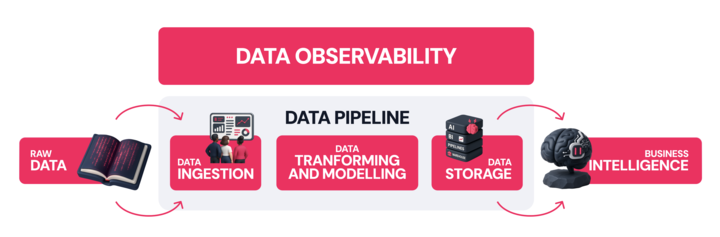
Data platforms have four primary jobs: ingestion, storage, processing, and access. However, the major types of data platforms differ in what they optimize for and who they're built to serve.
The 4 Main Types of Data Platforms
Data platforms commonly fall into four categories:
- Enterprise data platforms, built for governed, shared reporting and definitions
- Big data platforms, built for extreme volume, velocity, and variety
- Cloud data platforms, built for managed infrastructure and elastic scaling
- Customer data platforms, built for unified customer profiles and activation
Here's how each one works, who uses it, and where it fits.
Enterprise Data Platform (EDP)
An enterprise data platform is a centralized, governed architecture that consolidates data across an entire company. It brings data from operational systems and domain sources into a unified layer with shared definitions that multiple business units can use.
Enterprise data platforms suit large, complex companies where fragmentation is the core concern. In these environments, Finance needs a single definition of ARR, Sales needs a single view of the customer, and Operations needs consistent inventory numbers.
The EDP makes those shared definitions enforceable.
Enterprise data platforms are designed to support:
- Enterprise-wide reporting and financial consolidation
- Regulatory compliance and audit readiness
- Cross-department analytics built on consistent, governed metrics
- Master data management (MDM) for customer, product, or supplier records
Board reporting, audits, and M&A diligence depend on shared, traceable numbers. Enterprise data platforms exist to make that possible.
What EDPs Look Like
A global financial services company runs Snowflake as its centralized data warehouse, with standardized data models shared across 20+ business units, like risk, treasury, and retail banking. Queries from these business units run from the same governed layer.
An enterprise data platform exists to provide every part of the business with the same governed data and shared definitions.
Big Data Platform (BDP)
While the name is dated now, a big data platform is an architecture designed for high-volume, high-velocity, or high-variety data. These platforms emerged when conventional warehouses and relational systems couldn't process efficiently in high-volume environments. BDP supports data that arrives continuously, arrives in bulk, or arrives in formats that don't fit neatly into tables.
Big data platforms suit companies where scale is the defining constraint. Event streams, sensors, logs, and behavioral data can quickly outgrow traditional infrastructure. These platforms are typically owned by data engineering and machine learning teams.
Most big data platforms support:
- Clickstream and behavioral event data at a massive scale
- IoT sensor data from manufacturing, logistics, or connected devices
- Real-time event streams requiring low-latency processing
- ML training pipelines operating on very large datasets
Some workloads are infeasible or uneconomical without this type of architecture. Big data platforms exist to make high-scale processing practical.
What a BDP Looks Like
A ride-share company processes billions of GPS events per day using Spark-based streaming and batch pipelines. That data feeds pricing models, route optimization, fraud detection, and safety monitoring. The core question it answers is simple: can we process high-volume data fast enough to power systems that react in near real time?
Most big data platforms now run on cloud infrastructure. That's where the next category begins.
Cloud Data Platform
A cloud data platform is a managed data infrastructure delivered as a cloud service. The provider runs the underlying storage, compute, and scaling, while your data function focuses on pipelines, models, and consumption.
Cloud data platforms are a delivery model, not a distinct problem category. They can support enterprise and big data workloads. The difference is operational: managed services, elastic scaling, and consumption-based pricing.
Most cloud data platforms:
- Replace on-premises warehouses with managed services
- Scale analytics workloads without capacity planning
- Reduce infrastructure management overhead for engineering and IT
- Serve data across regions with cloud-native controls and replication
Cloud delivery removes hardware constraints and shifts effort from maintaining infrastructure to delivering reliable data products.
What a Cloud Data Platform Looks Like
A mid-market SaaS business migrates analytics from an on-premises SQL Server instance to Databricks on AWS. Fivetran handles ingestion, dbt manages transformations, and Looker serves dashboards. The data engineering function manages pipelines and models, while the cloud provider handles scaling and availability.
Customer Data Platform (CDP)
A customer data platform is a system that unifies customer data from multiple touchpoints, such as web behavior, mobile events, CRM records, email engagement, and transaction history, into persistent customer profiles for marketing and personalization.
Customer data platforms suit businesses with multi-channel customer journeys and multiple identifiers for the same person or account. They're typically owned by marketing operations, growth, and customer analytics functions, with support from data engineering.
Most customer data platforms support:
- Audience segmentation for paid media and lifecycle campaigns
- Customer journey analysis across web, app, and offline touchpoints
- Personalization using profile-level attributes and event history
- Attribution and measurement across acquisition and retention channels
- Feeding downstream tools with unified, deduplicated customer records
Without unified profiles, customer analytics and activation depend on brittle identity stitching and inconsistent definitions across tools.
What a CDP Looks Like
A retail brand uses Segment to collect events from its e-commerce site, mobile app, and loyalty program and unify them into customer profiles. Those profiles feed Braze for messaging, Google Ads for audience targeting, and Snowflake for deeper analysis. A customer data platform exists so every customer-facing system can operate on the same customer record.
Most stacks use more than one of these. The decision is where to start and what the primary platform investment should support.
How to Choose the Right Type of Data Platform
Use the questions below to identify the platform type that matches your primary use case. Each question maps directly to one category.
Do you need shared definitions and governed reporting across the business?
Choose an enterprise data platform when finance, sales, operations, and leadership need consistent metrics, controlled access, and audit-ready traceability.
Do you need to process data at extreme scale or speed?
Choose a big data platform when volume, velocity, or variety drives the architecture, such as event streams, IoT data, large-scale ML training, or low-latency processing.
Do you want managed infrastructure and elastic scaling in the cloud?
Choose a cloud data platform when the priority is a cloud delivery model, such as migrating off on-premises systems, scaling without capacity planning, and reducing infrastructure management overhead.
Do you need unified customer profiles for activation and measurement?
Choose a customer data platform when the primary requirement is resolving identities and using customer profiles for segmentation, personalization, attribution, and journey analysis.
Most mature stacks combine types. This guide helps you identify the primary category you're selecting for, then layer the others as needed.
Observe Your Data Platform With Sifflet
A data platform provides the infrastructure to build with data. It’s the factory for data products: executive dashboards, certified metrics, customer segments, operational datasets, and AI inputs.
As the platform scales, reliability becomes a separate discipline. Schemas evolve. Pipelines get refactored. Definitions shift as new consumers adopt the data. The platform can stay “up” while the outputs people rely on drift.
That gap is why data observability exists. Data platforms optimize for storage, compute, and throughput. They don’t tell you whether the data being served is current, consistent, and fit for use, or what downstream assets will be impacted when something changes.
Sifflet delivers that observability layer across modern stacks. It monitors data reliability end to end, maps lineage to show downstream impact, and ties incidents to owners so teams can validate changes and prioritize work. Because Sifflet is metadata-first, it surfaces what changed, where it changed, and what depends on it, without forcing teams to stitch context across tools.
Find out what your platform isn't telling you.














-p-500.png)
