



You meticulously budget for payroll and CapEx. But for data downtime? Nada.
That's an unbudgeted item that's quietly eating away at engineering output, slowing execution, and increasing your regulatory exposure.
What's Data Downtime?
Data downtime is the result of missing, inaccurate, and unusable data. It's everything from silent schema changes that corrupt downstream reports to data drift and anomalies that threaten mission-critical business activities.
Time spent addressing these issues is data downtime, too. It's time better spent building value than chasing down the same old data problems.
The data downtime cost calculator (included below) computes these hidden costs using straightforward formulas to generate a shareable number for your CEO and CDO.
In two minutes or less, you'll have a defensible, dollar-figure estimate of the yearly financial impact of data downtime. It’s the baseline number for making a persuasive ROI case for the solution to downtime: data observability.
Let's start with the people.
The Immediate Impact of Data Downtime
What's the most insidious drain on an IT budget?
Precious engineering hours spent chasing down data quality problems.
You've seen the research: data teams routinely spend 30–50% of their week on data janitoring, and too much of the other half digging through error logs and Slack threads.
These tedious, time-consuming activities aren’t reflected anywhere in the budget. Instead, they’re reflected only in stalled project delivery, reduced throughput, and a shrinking capacity for strategic work.
To calculate this loss of velocity, the calculator figures:
Cost of Labor = (Number of Engineers × Avg. Annual Salary) × % Time Spent on Firefighting
The Financial Reality
Consider a team of 10 engineers with an average annual cost of $200,000 each. If that team spends a conservative 25% of its time on firefighting, the unbudgeted yearly cost is $500,000.
This portion of the equation alone makes it obvious: downtime is not abstract, it's a real, six‑figure cost center.
But this bloated number underscores the value of Data Observability. Replacing manual monitoring and investigation with a data observability platform can reclaim 70–80% of this lost labor capacity in many organizations. That's a massive shift back toward revenue-generating work, and a solid start on an ROI for observability.
Let’s add another factor to our argument: the potential financial liability created by unreliable data.
Compliance Risk: Safeguarding Data Integrity
You track payroll to the dollar. You model CapEx down to the last server. But what about the regulatory-related financial risk hiding in your non-compliant data?
Compliance risk is the financial exposure you take on every time suspect data makes its way into an official report, regulatory filing, or audited disclosure. One bad number in the wrong place, and suddenly your PII headache is now a full-blown bottom-line heart attack.
The truth is, you don't diminish risk with slide decks and policy documents. You reduce it with verified proof. That means automated lineage that shows where regulated data came from, where it went, and how it was transformed.
We're talking data lineage that walks an auditor through every step without breaking a sweat.
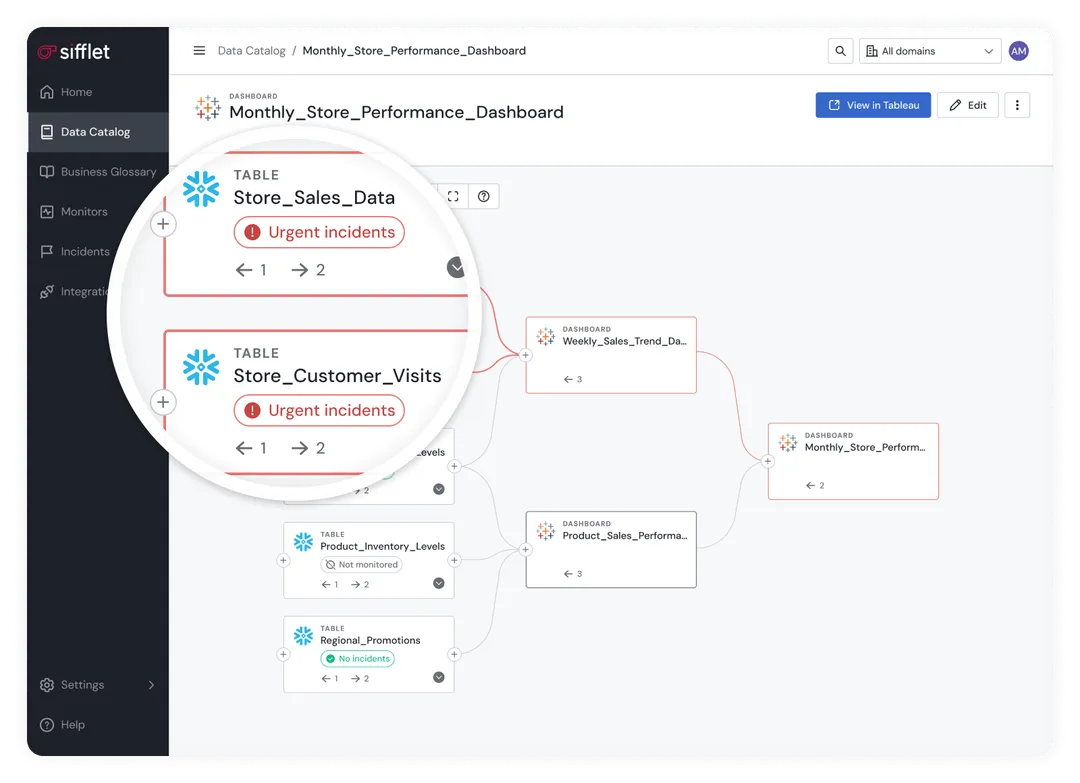
It also means incident history, as in an audit trail, that captures what went wrong, when it happened, who acknowledged it, and how it was resolved. In other words, an operational system of record for data quality, not a scattered trail of Jira tickets and Slack threads.
Controls like lineage and audit trails turn compliance from a mad scramble into an organized march. They are proof positive of the integrity of your reporting for auditors, regulators, and customers.So what if you’re not prepared?
How to Calculate the Pain
Regulators don't price mistakes gently.
Under GDPR, for example, penalties can reach up to 4% of annual revenue, or more. That's a number big enough to wreck an afternoon and a planning cycle.
The Formula: Max Compliance Exposure = Annual Revenue × Max Regulatory Penalty %
Although the calculator doesn't forecast audit outcomes, it does apply a simple heuristic: what portion of your revenue is realistically at risk given your controls and exposure? If your $300M enterprise carries even a 1% exposure from auditable data gaps, that's a $3M potential hit, whether you budgeted for it or not.
While compliance risks focus on protecting the business from external penalties, the final metric in your estimate reflects the value a company fails to capture or create.
Lost Opportunity Cost: The Impact on Revenue
Some costs hit once and fade, but lost opportunities can burn the bottom line for years. Delayed launches and scaled‑down bets bleed market share and leave profit on the table.
You can't itemize every missed bet. But you can model the drag.
The Data Downtime Calculator takes a conservative but realistic haircut on all revenue influenced by data‑driven decisions. In other words, the decisions you sat on or sized down because you didn't trust the data.
At a high level, the formula works like this:
Cost of Opportunity = Annual Revenue × Data Influence Factor × Revenue Degradation %
Note: The Data Influence Factor is the share of your revenue meaningfully shaped by data‑driven decisions.
The Business Impact
Run even the most modest scenario, and the stakes are easy to see. A 1% drag on a $100M revenue line is $ 1M in lost value. That's value that will never hit the P&L this year, next year, or any year after that.
These leaks appear in a variety of ways:
- Slowed decision velocity. Executives hesitate to launch new initiatives or expand into new markets because they just don't trust the numbers they're seeing.
- Revenue leaks. Market entries slip or underperform because the signals for feasibility and performance are stale, partial, or incorrect.
- Product roadmap errors: Teams back the wrong features or products, guided by noisy or misleading utilization or sales data.
These aren’t edge cases. These are the everyday symptoms of data downtime that budgets and expense lines never tell.
But now you can know.
Use our free, interactive calculator to figure the financial impact of data downtime on your enterprise, and make the case for data observability for enhanced productivity, ironclad compliance, and clear-eyed data for superior decision-making.
How to Use This Calculator
Our model breaks down the cost of data downtime into three critical categories:
- Labor Cost: The productivity lost when data engineers spend time firefighting incidents instead of building features.
- Compliance Risk: The potential financial exposure from regulatory fines (e.g., GDPR, CCPA) due to poor data governance.
- Opportunity Cost: The revenue missed when decision-makers can't trust the data to launch products or acquire customers.
Summing Up The Data Downtime Calculator
Data downtime is an unbudgeted liability. It's a drag on capacity, compliance, and competitiveness.
And it only gets worse as your data estate grows: more models, more dashboards, more surface area for things to break, and more places for those costs to hide.
Take the baseline from your calculator run, drop it into your next budget or board deck, and use it to fuel your argument for a proactive data observability strategy.














-p-500.png)
