



Engineering teams receive alerts all day long.
But those alerts rarely reflect the business consequences they carry.
Until, of course, an executive dashboard or a critical business process is compromised. That's when the pings and distress calls start flooding in. Only then does the impact, urgency, and focus become painfully clear.
This gap is where observability tools have exposed a fundamental flaw.
Business-aware observability exists to close it.
The Technical Roots of Data Observability
Data observability is the ability to monitor and understand the health and state of data by examining its external outputs and telemetry (metadata, logs, and metrics).
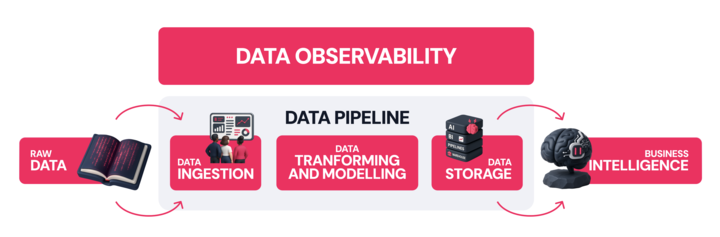
Historically, data observability has been a technical tool available mainly to engineering teams.
That exclusivity speaks more to its origins as an infrastructure-monitoring and application-performance-management tool than to any intentional design. But it has resulted in something of a silo, itself, secluded from the business and executive teams that need accurate data for all decisions.
As such, its inadvertent sequestering has created several unintended outcomes.
For starters, useless noise and alert fatigue is the byproduct of the ROT problem (Redundant, Obsolete, Trivial). When monitoring is disconnected from business context, teams end up stuck in a cycle of alert fatigue, maintaining data that has no real-world utility.
Additionally, technical teams solve issues for integrity, while business teams solve for utility. An engineer might "resolve" a technical symptom (such as a schema change), but the workflow remains broken because the underlying logic no longer meets the operational need.
This issue causes data to be technically "perfect" but contextually "wrong." Without business-aware guardrails, automated systems act on logical errors that technical-only tools can’t see, leading to unsupervised (and expensive) consequences.
Finally, not all data downtime carries the same price tag. Without business context, data teams are forced into "First-In, First-Out" troubleshooting. This lack of economic prioritization means your most expensive engineering resources are spent on low-value fixes while revenue-generating assets remain compromised.
These aren't indictments of the data teams that work diligently to address issues and anomalies with skill and determination.
It's an inherent shortcoming of the data observability platform itself.
The issue isn’t that observability detects the wrong things. It just has no way to understand what matters most to the enterprise.
Why Observability Needs Business Awareness
Observability shouldn't focus solely on detecting errors; it should also consider business capabilities and ROI.
By aligning data health with business objectives, operations, analytics, and executive teams reap massive rewards:
- Analytics
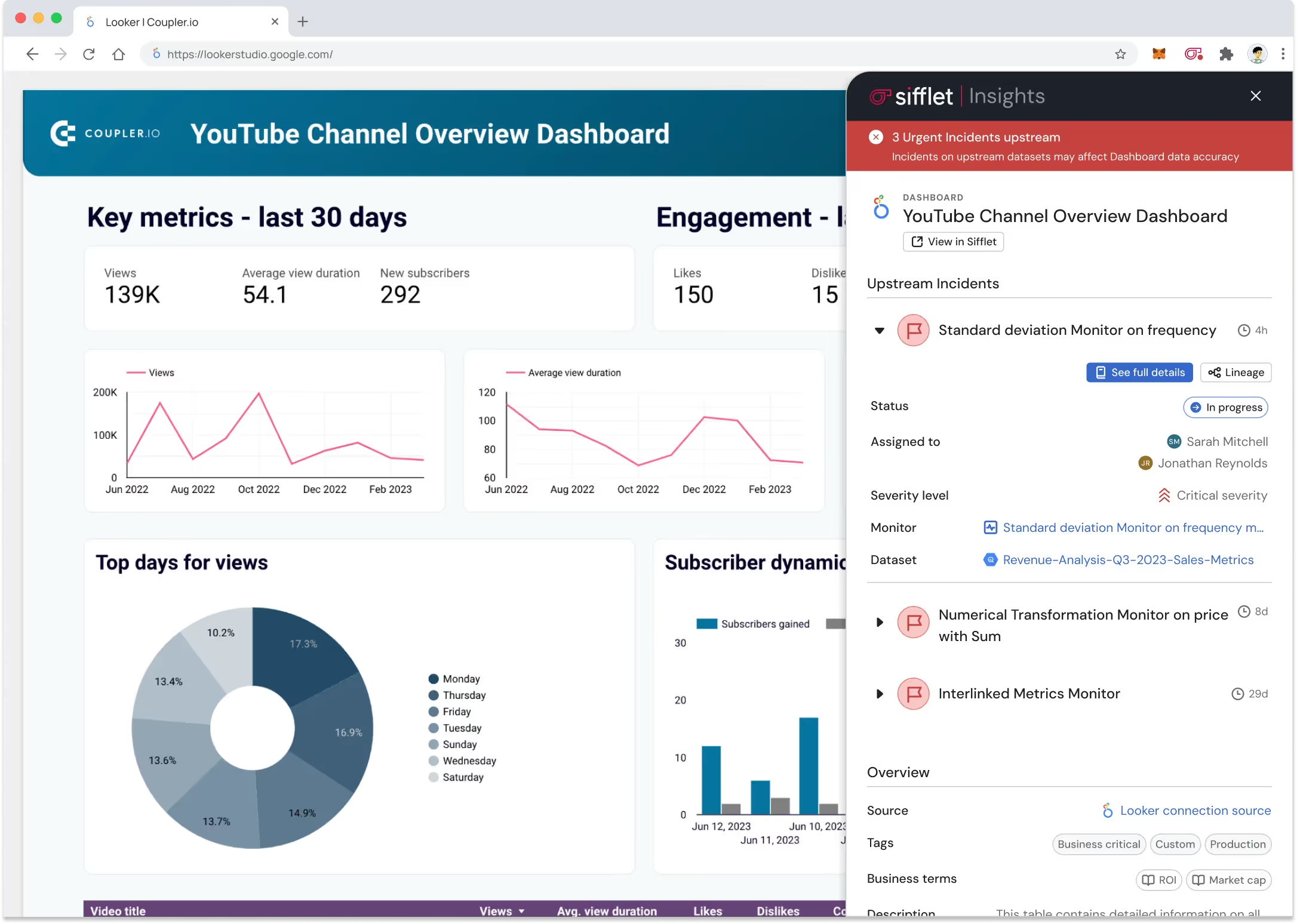
Analysts can spend their time uncovering insights rather than distrusting dashboards. With business-aware observability, they can instantly see the impact of a data issue and warn others before flawed reports lead to misinformed decisions.
- Marketing
Know when attribution models are accurate or if the "Ad Spend" data is stale. Insight into the health of inputs helps avoid overspending on underperforming channels based on faulty "healthy" data.
- Finance
Provides certainty in the month-end closing. Business-aware observability flags discrepancies in revenue data before it hits the CFO's desk, preventing costly restatements.
- Sales
Keeps CRM data reliable. Sales leaders can trust their pipeline forecasts, knowing the underlying data reflects real-time lead movement.
- C-Suite
Offers a "high-level trust score" for the entire organization. Executives can make strategic pivots with the confidence that the data they see isn't just present, but accurate and relevant.
These benefits all stem from a single shift: treating data observability as a business capability rather than just a technical flex.
To understand how that shift works in practice, it helps to define what business-aware observability actually is.
What is Business-Aware Observability?
Business-aware observability is monitoring data through the lens of business processes and outcomes.
It’s the intersection of technical insights and operational context. While traditional observability asks, "Does this table match the source and follow the schema?" Business-aware Observability asks, "Is this data accurate enough to trigger our automated supply chain order?"
Three major benefits come into play when to move toward business observability:
1. Smarter Operations
Traditional observability floods inboxes with alerts. Business-aware observability filters for criticality. It relieves alert fatigue and directs resources to the most critical issues first through precise alerting.
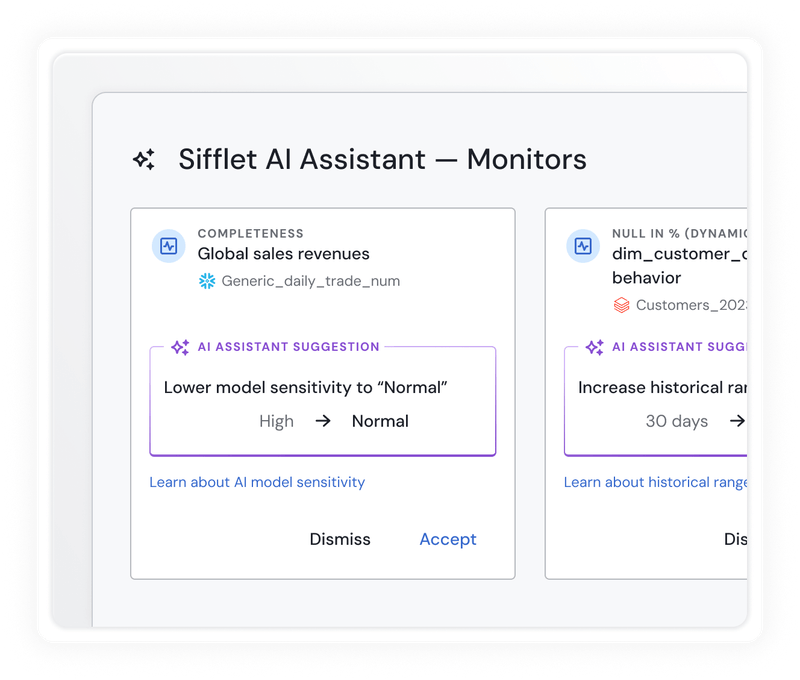
Standard Root Cause Analysis tells you where a pipeline broke; business-aware RCA tells you why a workflow, metric, or dashboard failed.
By mapping business logic to data flow, incident response teams can identify why data is "wrong" even when the pipeline is technically "up” and therefore offering functional restoration.
2. Strategic Governance
Traditional technical changes are often made in a vacuum. By overlaying data lineage with downstream business workflows, teams can perform a comprehensive "Pre-Mortem" impact analysis.
An engineer can see precisely which critical functions, from month-end reconciliation to customer billing, are at risk from a proposed schema change and carry out a proactive risk management process.
Connecting technical health to business functionality creates transparent and accountable Service Level Objectives (SLOs).
3. Organizational Trust
Visible Health Scores indicate that a report is ready for use. The platform provides objective confidence for data-driven decisions and unifies trust throughout the organization.
Business observability bridges the gap between those who build the data and those who use it. By embedding operational context into the platform, technical teams learn the "why" behind the metrics, and business teams learn to interpret the "how" of data health, creating a shared source of truth.
Few platforms are designed to deliver this model.
Sifflet is one of them.
Sifflet, The Business-Aware Data Observability Platform
Most tools focus on the "what," but Sifflet focuses on the "so what?" Sifflet invites and includes business and analytics teams directly in the data quality lifecycle, transforming observability from a technical chore into a strategic advantage.
Sifflet exemplifies business awareness through:
- KPI-to-Asset Mapping: Map technical tables directly to business terms in a centralized Business Glossary, ensuring everyone understands the real-world impact of every dataset.
- Business-Centric Data Contracts: Move beyond schema checks by establishing agreements on data quality between producers and consumers. That ensures data is "fit for purpose" before it ever reaches a decision-maker.
- Proactive Impact Analysis: Before a change is made, Sifflet visualizes the "Blast Radius", not just in terms of tables, but in terms of business processes. This analysis prevents technical updates from accidentally breaking critical finance or marketing workflows.
- End-to-End Lineage with BI Integration: Gain visibility from the source system down to the specific BI Dashboard. This allows teams to predict precisely which reports and dashboards will be affected by a technical anomaly.
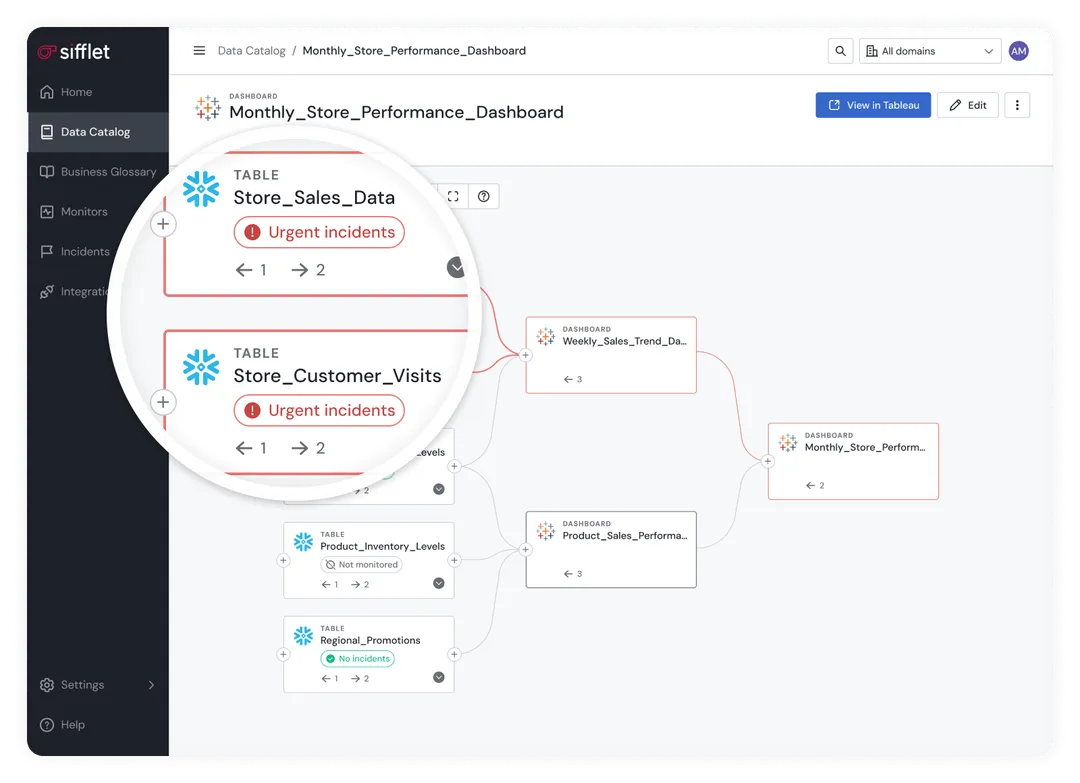
- Collaborative Incident Workflows: Sifflet allows business users to "subscribe" to the data they care about and participate in the resolution process. By allowing a Marketing Manager to flag a data discrepancy directly within the platform, Sifflet creates a bidirectional feedback loop that restores business trust.
- Operational Monitors: Go beyond technical health to monitor business logic. Catch discrepancies that technical-only tools miss, such as impossible pricing values or broken sales attribution logic.
Together, these capabilities shift observability from a reactive troubleshooting function into a proactive business discipline.
That shift is what business-aware observability makes possible.
Implement Business-Aware Observability Today
Every company is a data company, technical uptime is no longer the gold standard. Business utility is now the new objective.
Business-aware observability transforms technical metrics into enterprise confidence. Stop fixing bugs, and start protecting revenue, fueling accurate AI, and building a culture of trust.
Are you ready to close your gap between technical signals and business impact?
Schedule a demo with Sifflet today to see how business-aware observability turns data health into business confidence.













-p-500.png)
