



What's the most dangerous monitoring dashboard in your enterprise?
The green one that's lying to you.
We've all seen it: monitoring reports that your servers are cool, your Kubernetes clusters are healthy, and your Airflow pipelines finished right on time. From an infrastructure standpoint, everything's dandy. But downstream, the revenue report is missing $2 million in sales because a null value slipped through the cracks.
Infrastructure monitors like Datadog simply aren't built to catch these types of errors.
This is the Metadata Ceiling. It's the functional gap between uptime and accuracy. System performance and data integrity may be different sides of the same coin, but Datadog only shows you the heads while Sifflet shows you the tails and the truth.
Datadog As The Cloud Custodian
Datadog is a heavyweight in cloud infrastructure and Application Performance Monitoring (APM). Built as a pure SaaS platform, it specializes in high-fidelity visibility across multi-cloud environments, providing a "single pane of glass" for engineers managing thousands of instances across AWS, Azure, and GCP.
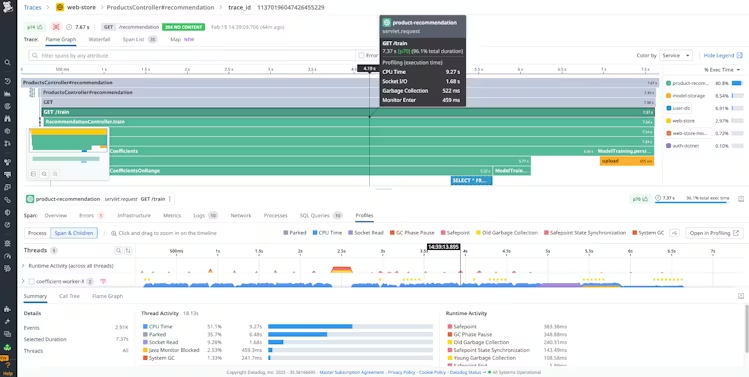
The platform's identity has evolved from simply sounding an alarm when things break to performing autonomous triage.
Instead of just telling you that a system is down, it uses Bits AI SRE to investigate the why immediately. By the time an engineer is notified, the agent has already scanned logs and traces to reconstruct the incident, pinpointing the specific microservice that failed and proposing a fix.
However, this only reinforces that Datadog's strength lies in its infrastructure-first DNA.
It's great at monitoring the pipes, servers, network throughput, and GPU clusters. While it can tell you with 100% certainty that your database is "up" and your queries are "fast," it remains unaware of whether the data inside those pipes is actually accurate.
Sifflet As The Intelligence Engine
While Datadog acts as the mechanical watchdog over your infrastructure, Sifflet serves as the Intelligence Engine for your data.
It's an end-to-end Data Observability platform designed to keep the information flowing through your pipelines (and everywhere else) clean, reliable, and fit for business consumption.
Sifflet is AI-Native, powered by a specialized trio of AI agents:
- Sentinel: This strategic agent automatically identifies your most critical data assets and recommends optimized monitoring coverage. It eliminates the toil of manual setup by learning the unique rhythms of your datasets and setting dynamic guardrails that evolve with your business.
- Sage: Functioning as the institutional memory of your data stack, Sage provides the context that infrastructure tools lack. When a data anomaly occurs, Sage leverages column-level lineage to explain not just what broke, but which downstream BI dashboards or AI models are now untrustworthy.
- Forge: Once an issue is identified, Forge provides a remediation blueprint. It suggests the exact SQL fixes or dbt rollbacks needed to restore data integrity, turning a potential day-long fire drill into a few minutes of targeted action.
Sifflet's DNA is Business-Aware. It doesn't just monitor for pipeline success; it monitors for Data Truth, ensuring that the insights reaching your business teams and executives are 100% accurate.
Where Is The Issue?
In the modern data stack, any friction between DevOps and data teams often boils down to their differing views about what to monitor.
APM tools like Datadog monitor the pipes. They track the mechanics of data delivery: Is the connection open? Is the latency low? Did the job finish with a success code?
When these technical signals flash green, the infrastructure team considers the mission accomplished.
However, the most dangerous failures are the silent ones. These occur when the pipes are perfectly healthy, but the data inside them isn't.
Why APM hits a wall:
- Logical success, functional failure
A SQL query written by a data engineer can run in under 10ms (a success in Datadog) while silently overwriting your Customer_LTV column with null values due to a faulty join.
- Semantic blindness
Infrastructure tools don't understand the meaning of the data. They can't tell the difference between a table full of legitimate transactions and a table full of test data that leaked into production.
- The downstream domino effect
Because APM tools don't map data dependencies, they can't warn you that a technically successful update in your staging warehouse just broke the machine learning model powering your real-time recommendations.
Breaking the Metadata Ceiling requires more than checking if the infrastructure is firing as planned. You need to analyze the health and well-being of the data itself.
Feature Deep Dive: Lineage, RCA, and Anomaly Detection
The technical gap between Datadog and Sifflet isn't just about what they monitor, but how deeply they see. While Datadog has enhanced its observability credentials through its Metaplane acquisition, it's still a horizontal giant in the space.
Conversely, Sifflet is a vertical specialist with the surgical precision required for high-stakes data environments.
1. Bolted-On Data Lineage vs. Built-In Truth
With its acquisition of Metaplane, Datadog has technically moved past basic service maps to offer column-level lineage. It's certainly an upgrade, but there's a catch: it's part of an infrastructure-first model, where lineage explains structure but doesn't drive prioritization or remediation.
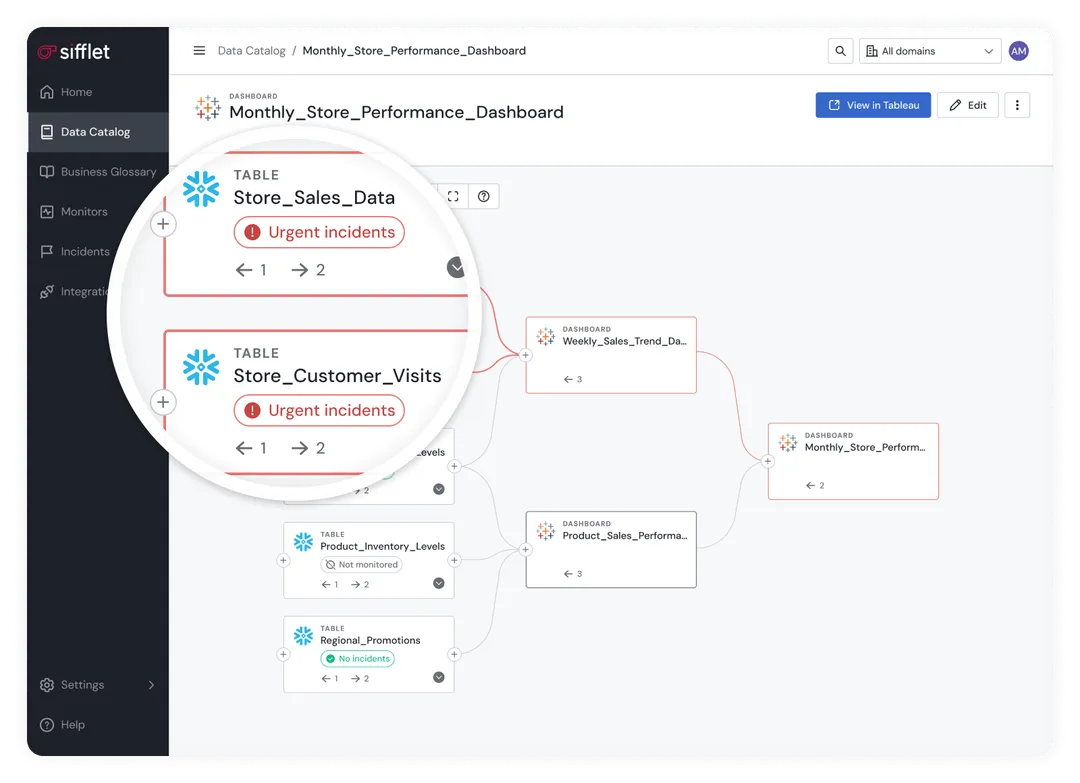
Sifflet uses field-level lineage as the lifeblood of its metadata-centric architecture. The moment an anomaly is detected, Sifflet connects the dots between the failing data and the business-critical metrics, dashboards, and analytics it supports.
Sifflet understands that a null value in "Table A" isn't just a database error, it's a direct threat to the Executive Revenue Dashboard or a high-priority AI model.
2. System Triage vs. Data Forensics in Root Cause Analysis
When an alert fires, Bits AI scans millions of logs, traces, and metrics to find the smoking gun in the infrastructure with its RCA, be it a rogue deployment or a failed container.
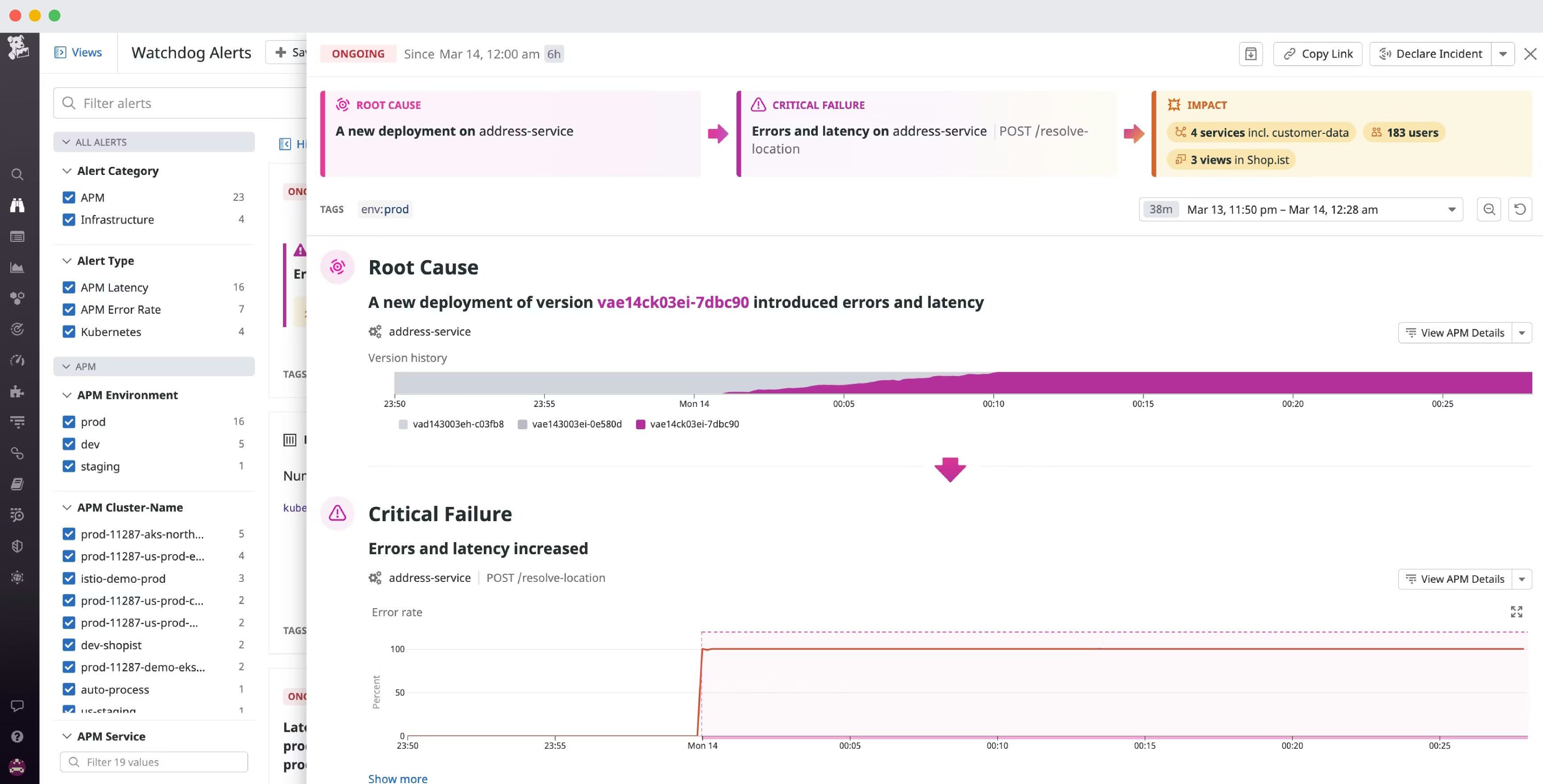
Sifflet's Sage performs data forensics. While Bits AI asks, "Why is the system down?", Sage asks, "Why is the data wrong?"
Sage correlates schema changes, dbt code updates, and historical anomalies to determine and share a complete rendering of what went sideways and why. It'll show you that a technically successful code merge in your Git repo is what actually caused a $0.00 value to propagate throughout your pipeline.
3. Noise Reduction vs. Business Context in Anomaly Detection
Datadog uses Watchdog and AI-powered thresholds to spot spikes in latency or error rates. Since it learns what regular traffic on your servers looks like, it's admittedly effective at reducing the number of alerts that might otherwise fire.
Better yet, Sifflet's Sentinel uses business context-aware anomaly detection. It doesn't just look for a spike in volume; it looks for a pattern shift. It also understands seasonality and business logic.
For example, Sentinel knows that a 20% drop in orders is a full-scale emergency on a Monday morning but a perfectly normal state on a Sunday night.
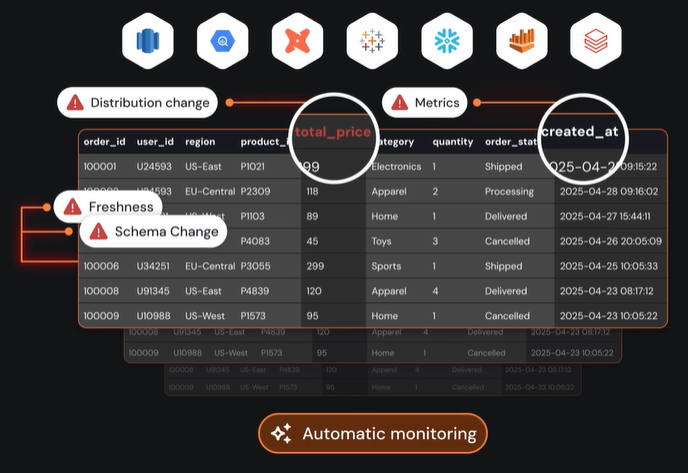
What's more, Sifflet prioritizes alerts based on the business-criticality of the asset involved. This prioritization is a core part of how Sifflet breaks the Metadata Ceiling. In a traditional monitoring setup, an alert is just an alert. To an infrastructure tool, a null value in a test table looks exactly the same as a null value in your Global Revenue table.
Sifflet, however, applies Business-Aware Logic to your alerting strategy so your engineers don't burn out on all the noise.
How Sifflet Prioritizes Your Peace of Mind
Sifflet gives you main benefits:
- Asset sensitivity
Sifflet allows tagging specific datasets as business-critical (e.g., Financials, Customer PII, or Executive Dashboards). An anomaly in these tables immediately triggers a high-severity alert, while a similar issue in a sandbox environment drops to the bottom of the list.
- Lineage-based impact
Because Sifflet understands the downstream impact, it can detect whether data drift in an upstream staging table will ultimately lead to misfires in an AI model.
It escalates the alert based on the severity of the potential fallout.
- Intelligent grouping
Sifflet goes even further to reduce alert-induced stress by grouping related issues into a single incident. If one upstream failure causes 50 downstream tables to look strange, you won't receive 50 separate alerts.
Sifflet sends one with all the details you need.
Which Platform Do I Choose?
The choice between Datadog and Sifflet is a matter of strategic alignment. To decide where to invest your engineering hours and budget, first identify the cost of failure for your specific circumstances.
Consider Datadog when:
- You're a Platform Engineer or SRE focused on the multi-cloud foundation.
- Your primary goal is availability, latency, and hardware health.
- You need to consolidate Infrastructure, Security, and APM into a single, high-fidelity command center.
Choose Sifflet when:
- You're a Data Engineer or Head of Analytics building a Data Product.
- The "cost of being wrong" is higher than the "cost of being down."
- You need business-aware lineage and context to understand how a technical glitch affects a specific C-suite KPI, AI model, or mission-critical business operation.
The Hybrid Choice
Still can't decide? For many, the ideal choice is a hybrid pairing.
Whatever you use for infrastructure monitoring—Datadog included—Sifflet sits above it as the business‑aware data layer that connects tables and models to KPIs, contracts, and executive‑facing dashboards.
This is a different decision than enabling 'data observability as a feature' inside an infra suite; it's a commitment to operationalizing business trust in data as a first‑class capability.
Accuracy is the New Uptime
The definition of a "healthy system" has fundamentally changed. We can no longer afford to celebrate a green dashboard if the data behind it is silently upending our most critical business operations and information.
Infrastructure monitors like Datadog have their place. They keep the lights on and the engine cool when managing the sheer complexity of the modern multi-cloud stack.
But that's only half the battle.
Sifflet is the Intelligence Engine that ensures the information inside your enterprise is business-aware and trusted. Sifflet gives data teams the surgical precision to catch the null values, logic errors, and schema drifts that traditional APM tools are simply blind to.
Don't let your next multi-million-dollar decision be a victim of green, but not seen, data errors.
Choose Sifflet to protect your truth, govern your data, and guarantee your insights are always true-to-life.
If the cost of being wrong now outweighs the cost of being down, it's time to treat data trust as infrastructure. Book your free demo today.












-p-500.png)
